

Introduction
Saudi Arabia has published a draft law that would replace the 2012 Arbitration Law. If your commercial contracts include an arbitration clause governed by Saudi law, it will affect you. The timing is no accident. Arbitration in the Kingdom is growing fast: the Saudi Center for Commercial Arbitration (SCCA) registered 182 new cases in 2025, up 63% on the previous year.
This article covers the main changes the draft proposes, what Saudi court decisions tell us about arbitration today, and what companies should be doing while the new law takes shape.
Background: from the 2012 law to the draft
The current Arbitration Law was issued by Royal Decree No. M/34 on 24/5/1433H (16 April 2012). It is based largely on the UNCITRAL Model Law on International Commercial Arbitration. Its Implementing Regulations followed in 2017, alongside the establishment of the SCCA, and together these steadily raised the Kingdom's profile as a seat of arbitration.
In July 2025, the government signalled its intention to strengthen the role of arbitration further. The National Competitiveness Center then published the draft law on the Istitlaa platform for public comment, and the consultation closed on 24 October 2025. If passed, the draft would repeal both the 2012 law (with its amendments) and the 2017 Implementing Regulations.
The reform comes against a supportive judicial backdrop, as the figures later in this article show.
The key proposed changes
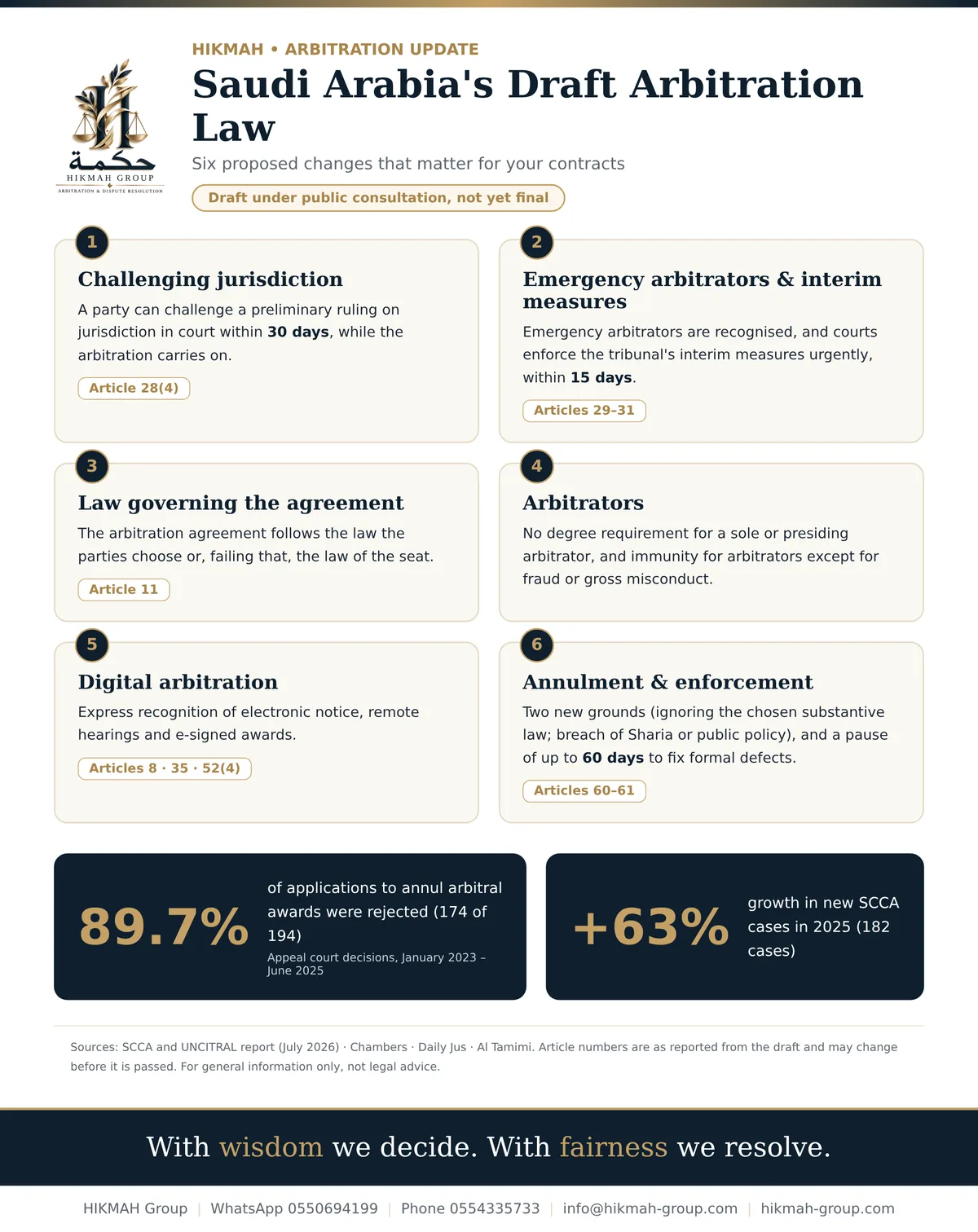
Overall, the draft gives tribunals a stronger role and limits court intervention. The main changes are set out below. Article numbers are as reported in the sources listed at the end and should be checked against the official text.
1. Challenging a tribunal's jurisdiction
The draft keeps the principle that a tribunal decides on its own jurisdiction, but adds a new route to challenge that decision (Article 28(4)). A party may ask the court to review a preliminary ruling on jurisdiction within 30 days, and the arbitration continues while the challenge is pending. Under the current law, a party usually has to wait for the final award and then bring an annulment action.
The draft does not say how closely the court should review the tribunal's ruling, whether it should look at the question afresh or only defer to the tribunal unless something is clearly wrong. That will be settled by the courts in practice.
2. Interim measures, emergency arbitrators and the courts
Article 29 empowers the tribunal to order interim measures, for example to preserve the status quo, prevent imminent harm, or protect assets or evidence. Under Article 30, the applicant must show that refusing the measure could cause harm that damages in the final award would not adequately remedy, and that it has a reasonable chance of succeeding on the merits.
The draft also brings emergency arbitrators within the definition of "arbitral tribunal", provided they are appointed under the rules the parties have chosen. A party holding an interim order from the tribunal can apply to the court for urgent enforcement within 15 days, and the court may refuse only on limited grounds (Article 31). The courts keep their power to grant interim measures before the tribunal is formed, or afterwards at the tribunal's request (Article 46(1)).
3. The arbitration agreement and its governing law
Under Article 11, the arbitration agreement is governed by the law the parties choose or, failing that, by the law of the seat. Article 12(3)(d) treats an agreement as being in writing if one party relies on it in its statement of claim or defence and the other party does not deny it.
4. Arbitrators and multi-party cases
The draft removes the requirement for a sole arbitrator or presiding arbitrator to hold a university degree in Sharia or law. It also gives arbitrators immunity from claims by the parties, except in cases of fraud or gross professional misconduct. Article 37 allows a third party bound by the arbitration agreement to join or be joined to the proceedings, provided it has a chance to be heard. Cases can only be consolidated if the parties agree.
5. Digital arbitration
The draft expressly recognises electronic notification, remote hearings and electronic signature of the award (Articles 8, 35 and 52(4)). This should make proceedings faster and less expensive.
6. Annulment and enforcement
The grounds for annulment largely follow the UNCITRAL Model Law, with two additions: the tribunal disregarding the substantive law the parties chose, and the award breaching Sharia or public policy. The court may also pause annulment proceedings for up to 60 days so the tribunal can fix formal defects without touching the substance of the award. Decisions on enforcement or annulment can be appealed to the Supreme Court.
What the courts are saying about arbitration today
Saudi courts have shown clear support for arbitration, rejecting around 90% of annulment applications. That is the main finding of a report published in July 2026 by the SCCA and the United Nations Commission on International Trade Law (UNCITRAL). It is the most recent systematic review of appeal court decisions in this area.
| Indicator | Figure |
|---|---|
| Appeal court decisions reviewed (January 2023 – June 2025) | 967 |
| Of which, applications to annul arbitral awards | 194 (20.1%) |
| Annulment applications rejected | 174 (89.7%) |
| Annulment applications granted | 20 (12 in full, 8 in part) |
| Combined earlier studies (2017–2025): applications / rejected | 565 / 518 (91.7%) |
The decisions show that courts treat the annulment grounds in Article 50 of the current law as an exhaustive list. The applications that succeeded were mostly about procedure, such as improper notification or a tribunal member not taking part in deliberations. Only 3 of the 194 applications succeeded on public policy grounds.
The report highlights two awards that were set aside. In one, the losing party never received the claimant's submissions and evidence (Riyadh, 2024). In the other, notice was sent to a WhatsApp number that was not the party's official number (Riyadh, 2023). By contrast, courts have accepted notice sent by email or text message where those channels were specified in the agreement. The practical lesson for contract drafting is clear.
What this means for your contracts now
You don't need to wait for the new law to improve your arbitration clauses. The points below help under both the current law and the draft. They are general recommendations, not legal advice on any particular situation.
- Be clear about how the arbitration will run. Either name an arbitral institution and its rules, or choose ad hoc arbitration and set out how the arbitrators will be appointed and which platform will manage the case (such as Tahakom). Vague wording like "arbitration under Saudi law" is what leads to disputes about the process itself.
- Name the seat of arbitration. The seat decides which court supports and supervises the arbitration, and its law will govern the arbitration agreement if you don't choose another.
- Choose the law that governs the arbitration agreement itself. Choosing the law of the main contract is not enough.
- Get the notice details right. Specify an email address and mobile number for each party, and commit to updating them in writing. One award was set aside because notice went to a number that was not officially registered.
- Use an odd number of arbitrators. The current law requires it. The draft keeps the rule but lets the parties fix a mistake by appointing an extra arbitrator. Don't rely on that fix.
- Specify the language. Under the draft, Arabic applies unless the parties agree otherwise. If you want English, say so.
- Review contracts that refer to unspecified rules or bodies. The more precise the clause, the less room there is to argue about the governing law and the competent forum.
It is not yet clear from the sources reviewed whether the new law will apply to existing arbitration agreements. This is worth watching closely once the final text is published.
Conclusion: the direction is clear, the details are not
The draft points towards more digital arbitration, stronger tribunals and courts that support rather than interfere. Several questions remain open, however: the final text, when it takes effect and how it handles existing agreements; how closely courts will review jurisdictional challenges; and how courts will apply the two new annulment grounds (disregarding the chosen substantive law, and breach of Sharia or public policy).
The new Enforcement Law also deserves attention, as it governs how arbitral awards are enforced. It was issued by Royal Decree No. M/237 on 20 April 2026 and published in the Umm Al-Qura Gazette on 1 May 2026. It takes effect 180 days after publication, around 28 October 2026. Check that it is in force before relying on it.
About HIKMAH
HIKMAH provides fully online ad hoc arbitration through Tahakom, the platform accredited by the Saudi Ministry of Justice. We also help companies draft clear arbitration clauses that prevent disputes about the process from the start.
See our servicesSources
All pages accessed on 1 November 2026:
- Al Tamimi – Saudi Arabia's Draft Arbitration Law: The Next Chapter in the Kingdom's Arbitration Reform
- Al Tamimi – Saudi Arabia Adopts New Enforcement Law Reforms
- Daily Jus – Saudi Arabia's Draft Arbitration Law: Recalibrating the Role of Courts in the Arbitral Process (June 2026)
- Aceris Law – Saudi Arbitration: What the 2026 SCCA Country Report Shows
- Al Watan – SCCA and UNCITRAL report on applications to annul arbitral awards
- Chambers – International Arbitration 2026 Comparisons (Saudi Arabia)
- Umm Al-Qura Gazette – draft laws published on the Istitlaa platform, including the draft Arbitration Law
This article is for general information only and is not legal advice.